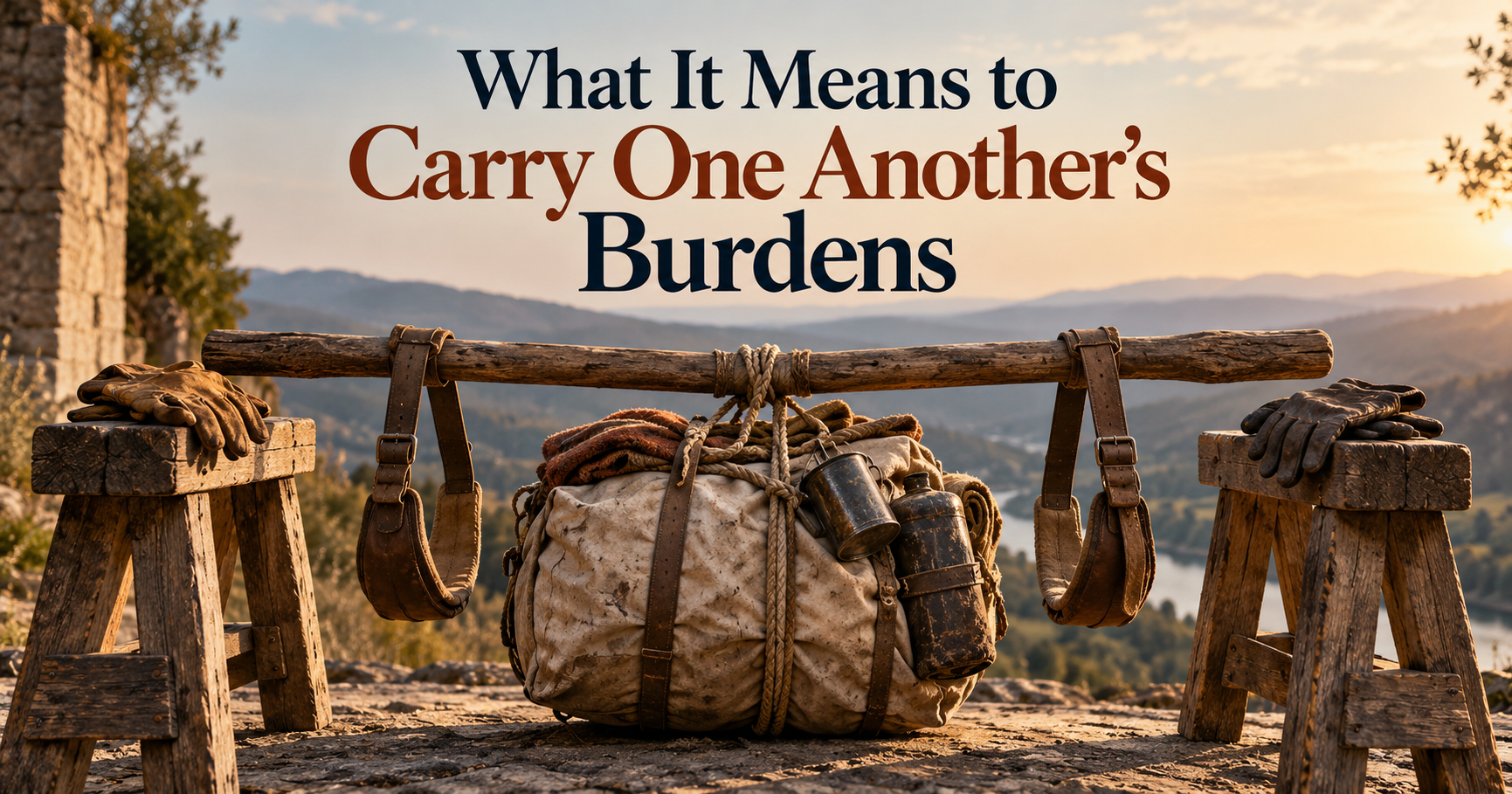
Galatians 6 places two instructions close enough to make us pause.
“Carry each other’s burdens, and in this way you will fulfill the law of Christ” (verse 2, NIV).
A few lines later Paul writes,
“Each one should carry their own load” (verse 5, NIV).
So which is it? Do we carry one another, or does each person carry what belongs to them?
Christian community needs both truths. Without shared burdens, people are left to collapse alone. Without personal responsibility, care can become rescue that never allows anyone to stand.
Some Weight Is Too Heavy to Carry Alone
The word “burden” in verse 2 points to weight that presses heavily upon a person. Paul’s immediate setting includes a believer caught in sin who needs gentle restoration. It soon expands to weariness in doing good.
The church is not meant to watch from a distance while someone struggles under crushing weight.
Burden-bearing may involve practical help, patient listening, financial support, a meal, transportation, prayer, or temporary relief from a responsibility. At times, it means sitting with someone whose pain cannot be solved quickly.
Advice has its place. It becomes hollow when the burden is practical and we offer only words.
Paul calls this “the law of Christ.” Jesus carried what we could never carry for ourselves. His self-giving love becomes the pattern for life among His people.
Help Without Taking Over
Verse 5 keeps burden-bearing from becoming control. Each believer remains answerable to God for the life and work entrusted to them.
Helping someone does not mean making every decision for them. We can support a weary person without treating that person as incapable. We can provide resources while leaving room for agency, obedience, and growth.
This is especially important for leaders and caregivers. Help can become possessive when the helper needs to remain necessary. We begin to make choices that belong to the other person, then feel resentful when our advice is not followed.
Healthy support asks, “What weight can I help carry?” It also asks, “What responsibility still belongs to you?”
The line will not always be obvious. Love requires patience and judgment.
Personal Responsibility Does Not Excuse Neglect
“Carry your own load” can be used harshly. It may become a religious way of telling exhausted people to manage alone.
That reading ignores the instruction Paul has just given. Personal responsibility is never permission for communal indifference.
A believer can remain responsible for an assignment and still need help carrying its present weight. A parent may need respite. A ministry worker may need someone else to cover a task. A grieving person may need ordinary responsibilities simplified for a season.
Receiving help does not erase responsibility. It can make continued faithfulness possible.
The church should be a place where people can admit strain before they reach collapse. If someone must fail publicly before support becomes available, the community has learned to respond too late.
Restore Gently
Galatians 6 begins with someone “caught in a sin.” Paul tells spiritual believers to restore that person gently while watching themselves.
Gentleness matters because restoration is not superiority. Those who help remain aware of their own vulnerability.
If the church should approach a fallen person with this kind of care, how much more should it come alongside someone who has served faithfully and become weary?
Weariness should not be treated as disloyalty. A request for help is not necessarily a lack of commitment. Sometimes the most responsible sentence a person can speak is, “This has become too heavy for me to carry alone.”
A mature community knows how to hear that sentence without shame or panic.
Build a Culture Where Help Is Normal
Burden-bearing should not depend entirely upon emergencies. Churches can build patterns that make shared care ordinary.
Responsibilities should be clear enough to share. Leaders should notice sustained overload and ask questions before resentment or illness forces a crisis. Teams need honest conversations about capacity, not constant pressure to prove devotion.
People also need permission to offer specific help. “Let me know if you need anything” often places another task upon the tired person. A better offer names what we can do and allows the person to answer freely.
At the same time, each believer remains responsible to speak honestly, receive appropriate help, and continue whatever obedience still belongs to them.
Christian partnership neither abandons people beneath crushing weight nor carries their entire life for them.
We come alongside. We share what has become too heavy. We help one another remain faithful to Christ.


You must be logged in to post a comment.