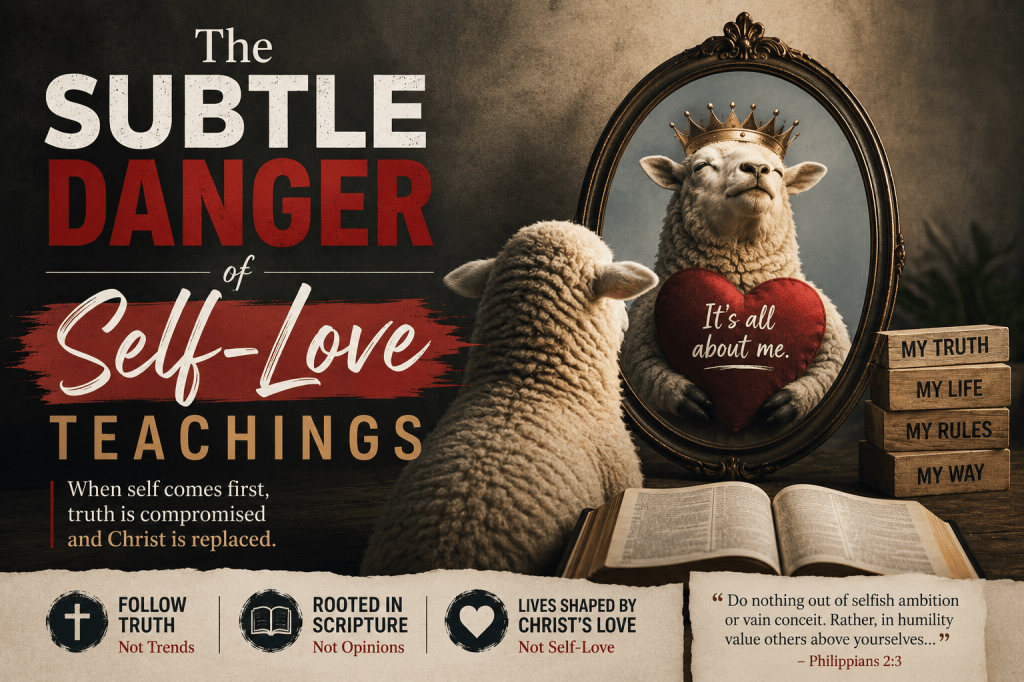
A growing emphasis on “self-love” has quietly taken root across many Christian platforms. It appears in sermons, devotionals, podcasts, and especially in social media content. At first glance, it seems necessary. Many people are wounded, exhausted, insecure, and burdened by shame. Language that speaks of healing, dignity, and restoration naturally resonates. But resonance is not the same as truth.
Beneath the surface, a more serious concern emerges. Much of what is now described as “self-love” subtly promotes a vision of life that Jesus never advanced. Increasingly, the Christian life is being framed in this order: Jesus–You–Others if not You–Jesus–Others. Yet the pattern revealed in the life and teaching of Jesus points in another direction: Jesus–Others–You.
That difference is not cosmetic. It is formative. The order of love reveals our perspective of discipleship. When the self becomes the immediate priority after Jesus or even before Jesus, the center of gravity shifts. Without realizing it, we can begin to interpret faith through the lens of personal fulfillment, emotional comfort, self-preservation, and autonomous ethics. Jesus remains in the vocabulary, but the self quietly becomes the reference point.
The question, then, is not simply what we affirm. It is what is being formed in us over time. The New Testament does not call believers to hate themselves or to live in emotional destruction. But neither does it make self-love the organizing principle of Christian maturity. The dominant call of Jesus is not self-celebration, but self-denial: “If anyone would come after me, let him deny himself and take up his cross and follow me” (Mark 8:34).
This same pattern appears clearly in Epistle to the Philippians 2:1–4. Believers are instructed to do nothing from selfish ambition or conceit, but in humility to count others more significant than themselves. This is not merely a call to be aware of others or to occasionally consider their needs. It is a call to prefer others in love.
Paul reinforces this while writing to the Romans, that believers should “be devoted to one another in love” and “honor one another above yourselves” (Romans 12:10 NIV). The ethic is not mutual self-interest carefully balanced, it is self-giving preference rooted in humility.
This does not eliminate self-concern. It reorders it. Paul is careful: “Let each of you look not only to his own interests, but also to the interests of others.” The issue is not the existence of personal concern, but its dominance. And then he anchors everything in Christ. Jesus did not grasp at status. He did not organize his life around self-preservation. He emptied himself, took the form of a servant, and humbled himself even to death. The Christian life is therefore cruciform, having the shape of the cross, and moving outward.
This is why the popular slogan, “you must love yourself before you can love others,” requires careful examination. It sounds necessary and compelling. For those recovering from rejection or shame, it can feel deeply affirming. But the question is not whether it resonates. The question is whether it reflects the pattern of New Testament teaching.
Scripture never builds love for others on a prior project of loving the self. Instead, it assumes a natural self-regard already exists and redirects it. Paul states in Epistle to the Ephesians 5:29, “For no one ever hated his own flesh, but nourishes and cherishes it.” That assumption is important. Ordinary human beings instinctively care for themselves. They protect, preserve, and attend to their own well-being.
When that instinct breaks down, the situation is not normative. It is a sign of distortion that requires care, healing, and pastoral attention. But Christian approach is not built on the exception. It comes from the norm that no one hates themselves.
This reframes Jesus’ command to “love your neighbor as yourself.” The command is not an invitation to develop self-love as a separate project. It is a redirection of existing self-concern outward toward others. In other words, the energy we naturally invest in ourselves becomes the measure of how we are to love our neighbor.
At this point, another imbalance often emerges. Some believers, reacting against self-centeredness, move toward a different distortion. They give endlessly, serve without restraint, and ignore legitimate limitations. They assume that true spirituality always requires total depletion. But that is not what Scripture teaches. Paul introduces an important principle in 2 Corinthians 8:12: “If the willingness is there, the gift is acceptable according to what one has, not according to what one does not have.”
This matters. God does not require us to operate from what we do not possess. Christian sacrifice is real, but it is not performative self-destruction. Faithful love includes stewardship of one’s possessions, strength, responsibilities, and calling. To ignore that is not holiness. It is misalignment.
Many who attempt to live in constant depletion eventually collapse, not because they lack devotion, but because they were never taught the difference between sacrifice and unwise self-erasure.
So the issue is not whether the self should be cared for. It must be. The body matters. The soul matters. Rest matters. Healing matters. Boundaries, in their proper place, can be necessary. But these must not become the organizing center. All of these realities must be ordered under Christ. Otherwise, they quietly reorganize life around the self again, only in more refined language.
The biblical alternative to modern self-love is therefore not self-hatred. It is rightly ordered love. Christ stands at the center. Others are genuinely preferred. The self is faithfully stewarded as a life that belongs to God.
This concern, however, goes beyond individual practice. It touches the long-term formation of the church. Teachings do not remain isolated ideas. They form instincts. Instincts shape communities. Over time, communities develop cultures, and cultures determine the future of the church.
It is worth asking where these patterns lead. What kind of church emerges if believers are consistently discipled into self-prioritization, even in subtle forms? What happens when the language of fulfillment gradually replaces the language of the cross? What remains of discipleship when self-preservation becomes instinctive and self-denial becomes unfamiliar?
A generation can retain Christian vocabulary while slowly losing apostolic patterns underneath. The concern, then, is not only about biblical precision in the present. It is about the kind of faith that will exist decades from now. The teachings we normalize today are shaping the church that will exist one hundred years from now.
Not every message that comforts the self strengthens the soul. Some teachings soothe while quietly weakening the call to follow Christ.
So what must change? Not our concern for wounded people. That concern is deeply biblical. But the framework through which we seek their healing must be corrected. We must not heal people into self-centeredness. We must heal them into Christlikeness.
The goal of Christian formation is not a more affirmed self at the center of life. It is a life so secure in Christ that it is free to love, serve, give, and sacrifice without being destroyed.
The way of Jesus is not Jesus–You–Others, It is Jesus–Others–You. And when Christ truly holds that place, the self is not lost. It is redeemed, reordered, and released into love.




You must be logged in to post a comment.