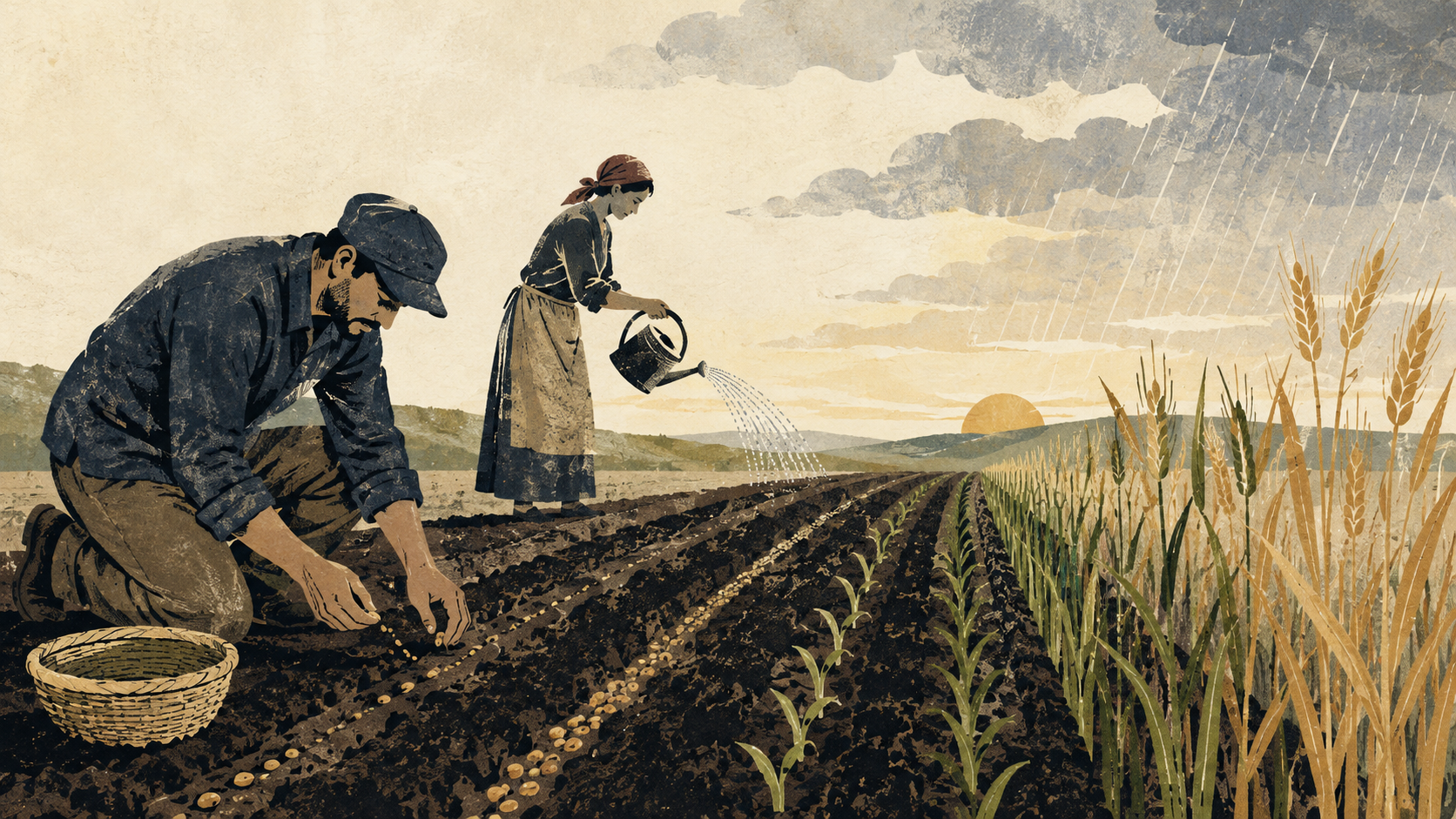
Christian ministry is often caught between two serious errors.
The first is passivity. Because only God can transform a life, we may conclude that human action hardly matters. We wait for God to work while neglecting the planting and watering he has assigned to us.
The second is control. We act as though the success of God’s mission depends upon our ingenuity, intensity, personality, or ability to secure measurable results.
Scripture permits neither conclusion.
God’s work is not ours to control, but it is ours to join.
Planting, Watering, and Divine Growth
Addressing division within the Corinthian church, Paul writes:
“I planted the seed, Apollos watered it, but God has been making it grow” (1 Corinthians 3:6).
This simple agricultural picture establishes the proper relationship between divine agency and human responsibility.
Paul planted. That labour mattered.
Apollos watered. His labour also mattered.
But God gave the growth.
Planting and watering require effort, wisdom, sacrifice, patience, and perseverance. Paul does not say that God’s sovereignty makes these activities unnecessary. Nor does he suggest that the ministers produced spiritual life by performing them.
Human participation is real, but divine action is decisive.
We can proclaim Christ, teach Scripture, pray, counsel, serve, organize, invite, and disciple. We can create environments in which people are treated with dignity and truth is clearly communicated. But we cannot command spiritual life to emerge.
Only God can awaken faith, open the heart, produce repentance, and form the character of Christ within a person.
Dependence Is Not Inactivity
“God gives the growth” must never become an excuse for neglect.
A farmer who believes that life comes from God still prepares the ground, plants the seed, removes obstacles, and waters responsibly. Trust in God’s provision strengthens faithful labour rather than replacing it.
Likewise, prayer does not make preparation unnecessary. Dependence upon the Holy Spirit does not excuse careless teaching, poor leadership, broken promises, or refusal to learn. God’s sovereignty does not relieve the Church of its responsibility to proclaim the gospel clearly and make disciples patiently.
Dependence means that we work without imagining ourselves to be the source of life.
Paul describes his own ministry in precisely these terms:
“I worked harder than all of them, yet not I, but the grace of God that was with me” (1 Corinthians 15:10).
Paul can say, “I worked,” without denying grace. He can say, “Grace worked,” without denying his own labour.
That is the grammar of Christian service. We act because God has acted. We labour through the strength that we have received.
Responsibility Is Not Control
Once we forget that growth belongs to God, ministry becomes anxious.
We begin to treat people as outcomes to be produced. We pressure them into appearing changed before genuine formation has occurred. We may confuse emotional response with repentance, attendance with discipleship, public enthusiasm with spiritual maturity, or numerical expansion with divine approval.
Visible results are not unimportant. Churches should examine whether their ministry is faithful, fruitful, and genuinely serving people. Responsible leaders should learn from evidence, correct failing practices, and steward resources wisely.
But evaluation becomes distortion when outcomes are treated as possessions or as final proof of personal worth.
A ministry can draw a crowd and still fail to form people well. A faithful witness may appear unsuccessful for a long time before its fruit becomes visible. Numbers can reveal something important, but they cannot tell the whole spiritual story.
The desire for measurable fruit becomes dangerous when it tempts us to manufacture what only God can produce.
People Are Not Ministry Products
Paul reminds the Corinthians that they are “God’s field” and “God’s building” (1 Corinthians 3:9).
The repeated possessive matters. The people do not belong to Paul or Apollos. The Church does not exist to validate the identity, reputation, or ambitions of its ministers.
People are not evidence that our methods work. They are people loved by God and placed under our care.
This changes the spirit of ministry.
We cannot force people to mature on our preferred timetable. We cannot manipulate them into making decisions just to report success. We cannot treat their vulnerability as material for building our public image.
Faithful ministry speaks truth, creates appropriate structures, offers patient care, exercises discipline when necessary, and calls people to obedience. Yet it does all this in recognition that the field belongs to God.
Servants cultivate. They do not possess.
When Growth Appears Slow
Slow growth can produce deep discouragement.
We pray, teach, invite, serve, or give, yet the expected change does not come. A person we have discipled seems to regress. A ministry remains small. A congregation resists necessary formation. Years of quiet service appear to have achieved very little.
In such seasons, the distinction between labour and growth becomes liberating.
A delayed result does not automatically mean that obedience was wasted.
Some seeds remain beneath the soil longer than we expect. Some fruit becomes visible only after another servant continues the work. Some acts of faithfulness contribute to an outcome we may never personally witness.
This does not mean persisting with every ineffective method forever. Faithfulness may require adaptation, correction, or the courageous ending of work that has completed its purpose. We should remain teachable and willing to examine our practices.
But we must not confuse the absence of immediate results with the absence of God’s activity.
The right question is not merely, “Did I achieve the outcome I wanted?” It is also, “Was I faithful to what God actually entrusted to me?”
Success Can Also Become a Test
Visible growth presents its own spiritual dangers.
When ministry flourishes, ministers may begin to believe they created the life that appears around them. The language of stewardship quietly gives way to ownership. Gratitude becomes entitlement. A calling becomes personal territory.
Paul’s corrective is direct:
“So neither the one who plants nor the one who waters is anything, but only God, who makes things grow” (1 Corinthians 3:7).
Paul is not declaring ministry worthless. He is denying that the servant is the source of grace.
No leader becomes indispensable because God has chosen to work through that leader. No ministry owns the people it has served. No servant can rightfully claim what God’s power has produced.
Success must therefore deepen gratitude and humility. The more evident the fruit, the more clearly we should acknowledge the One who gave the growth.
Recovering Freedom in Service
The distinction between labour and growth releases us from burdens God never assigned.
We do not have to manipulate people to prove that our service matters. We do not have to compare our harvest with another person’s field. We do not have to abandon a responsibility merely because its fruit is slow. We do not have to claim ownership when God grants visible success.
We are responsible for obedience, preparation, integrity, love, perseverance, and wise stewardship.
God remains responsible for giving life.
This freedom does not make us careless. It makes sustained faithfulness possible. We can work diligently without acting as though everything depends upon us.
Questions for Honest Discernment
Every Christian minister should periodically ask:
- Am I neglecting something because I have disguised inactivity as dependence upon God?
- Am I trying to control a result that belongs to God?
- Have I begun treating people as evidence of my effectiveness?
- Am I measuring my worth by another person’s visible fruit?
- Have I abandoned a genuine assignment because growth appeared slow?
- Do I need to change my method while remaining faithful to the mission?
- Can I celebrate fruit that appears through someone else’s labour?
These questions return ministry to its proper order: assignment from God, faithful labour from servants, and growth through divine grace.
Conclusion
Our labour matters, but it does not create spiritual life.
God calls us to prepare, plant, water, teach, serve, and persevere. He also calls us to surrender our need to possess the outcome.
Dependence is not inactivity. Responsibility is not control.
Do the work God has entrusted to you with care and courage. Evaluate it honestly. Correct what is unfaithful. Persevere when the fruit is hidden. Then leave room for God to accomplish what no technique, personality, or programme can produce.
Plant faithfully. Water patiently. Let God remain the giver of growth.


You must be logged in to post a comment.