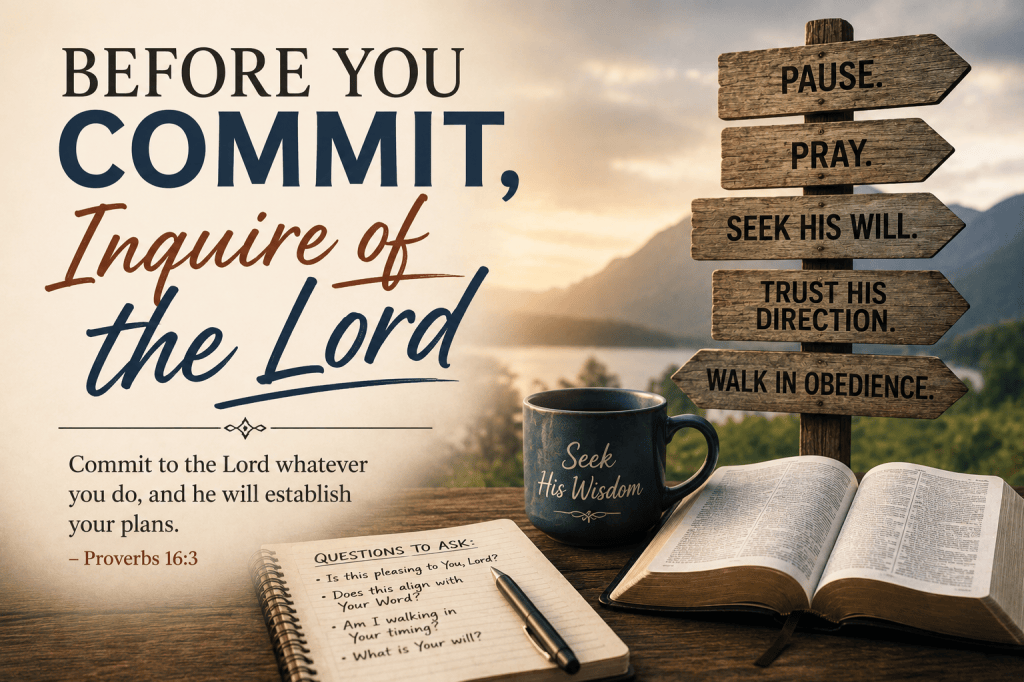
“The Israelites sampled their provisions but did not inquire of the LORD.” Josh 9:14 (NIV)
One of the repeated struggles Israel faced under Joshua was not that they lacked courage. They were brave. The problem was that they did not always stop to ask God for direction before making important decisions.
We see this clearly in Josh 7. Israel went up confidently against the small city of Ai, expecting an easy victory, but instead they suffered a painful defeat (Josh 7:4–5). What they did not know was that Achan’s hidden sin had brought God’s judgment on the camp (Josh 7:11–12). Israel could not see the real issue, but God could. When Joshua finally sought the Lord, God revealed what no one else could have discovered (Josh 7:13–15). The lesson was simple: God’s people cannot depend only on what they see, what they think, or what worked before. We need the God who sees what is hidden (1 Sam 16:7).
But only two chapters later, Israel made the same kind of mistake again.
The Gibeonites came with worn-out sacks, patched wineskins, old sandals, and dry, mouldy bread to make their story sound believable (Josh 9:4–5). From the outside, everything seemed to check out. Israel looked at the evidence, believed what they saw, and made a covenant with them. But they did not ask the Lord what He thought (Josh 9:14). Three days later, they discovered the truth. These people were not from a faraway land at all. They were nearby neighbours who had deceived them (Josh 9:16–18).
Their mistake was not that they were foolish. Their mistake was that they moved ahead without depending on God. Instead of trusting the Lord with all their hearts, they leaned on their own understanding (Pro 3:5).
Moses gives us a better example. When something was unclear, he did not pretend to know the answer. He waited before the Lord until God made His will clear (Exo 33:7–11). When the daughters of Zelophehad brought a difficult case, Moses brought it before the Lord instead of answering from experience alone (Num 27:1–5). When questions came up about the Passover, he waited again for God’s instruction (Num 9:6–8). That kind of dependence saved Israel from many costly mistakes. Yet even Moses stumbled at Meribah when, under pressure, he acted out of frustration instead of following God’s specific word (Num 20:10–12). Even strong leaders can fail when they stop listening to God.
This lesson still speaks to us today. Not everything is as it seems. Scripture reminds us that “there is a way that seems right to a man, but in the end it leads to death” (Prov 14:12). An attractive opportunity is not always God’s will. A convincing story is not always the truth. A good offer is not always a God-given assignment.
God’s Word also teaches us not to rush into conclusions: “To answer before listening, that is folly and shame” (Prov 18:13). Wisdom listens carefully. It slows down, hears the whole matter, and seeks understanding before making a decision.
We also need to be careful not to judge people or situations only by what we see or feel. When Samuel was ready to anoint Eliab, God reminded him, “People look at the outward appearance, but the LORD looks at the heart” (1 Sam 16:7). Our view is limited, but God’s understanding is perfect. He sees farther, deeper, and clearer than we do (Isa 55:8–9).
That is why we need to learn the habit of pausing before we commit ourselves. Before making promises, bring your concerns to God in prayer (Phil 4:6). If you need wisdom, ask Him; He gives generously (Jam 1:5). Be quick to listen and slow to speak (Jam 1:19). Test things instead of accepting everything at face value (1 Thess 5:21). And let the peace of Christ guide your heart before you move forward (Col 3:15).
Many regrets could be avoided if we learned to ask one simple question before every important decision: “Lord, what do You say?” instead of rushing ahead with, “What do I want?” Like the psalmist, our prayer should be, “Show me your ways, LORD, teach me your paths; guide me in your truth” (Psa 25:4–5).
God never rebukes His children for waiting on Him. What He warns against is making plans without seeking His counsel (Jam 4:13–15). To those who trust Him, He gives this beautiful promise: “I will instruct you and teach you in the way you should go; I will counsel you with my loving eye on you” (Psa 32:8).
So before you make your next important decision, pause long enough to acknowledge the Lord. Ask Him for wisdom. Wait for His direction. He has promised to make your paths straight (Pro 3:6).

