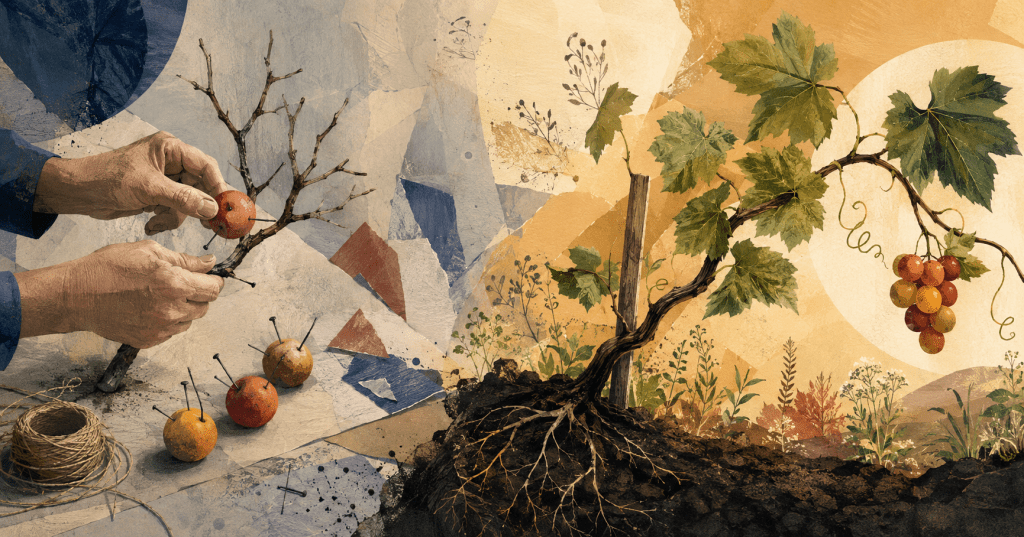
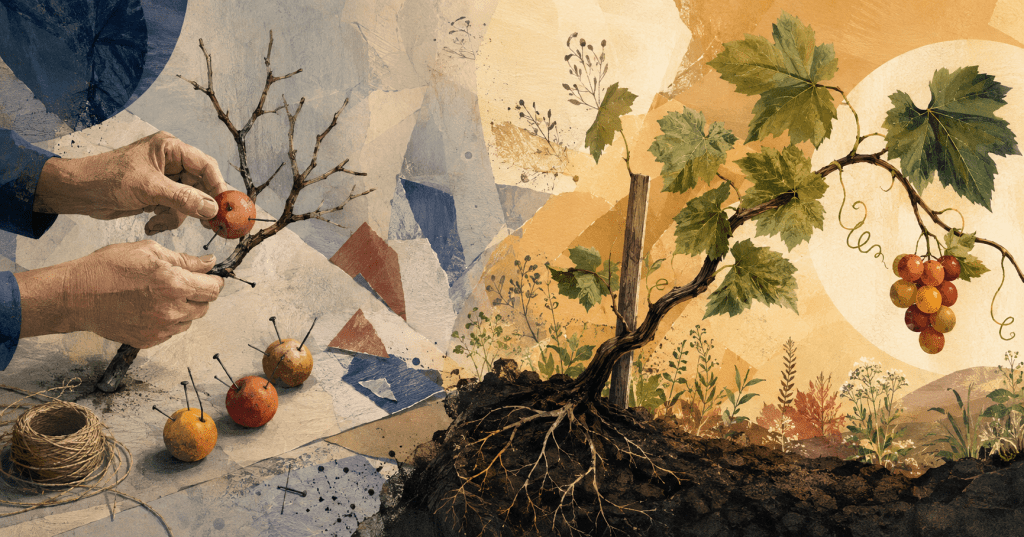
The Limits of Religious Pressure
Christians often respond to moral failure by increasing pressure. They resolve to be more patient, demand that they stop feeling anxious, command themselves to become joyful, or attempt to suppress disordered desires through willpower alone.
Discipline, intention, and obedience have a necessary place in Christian formation. The problem is not effort itself. The problem is treating the self as the source of transformation.
When spiritual fruit is pursued primarily through pressure, the usual results are frustration, exhaustion, concealment, or hypocrisy. A person may sustain an outward performance for a time while the deeper desires remain untouched. Religious effort can restrain behaviour, but restraint alone is not the same as renewal.
Jesus gives a different account of fruitfulness in John 15. A branch does not generate life from itself. It bears fruit because it remains in the vine. Christian fruitfulness is therefore dependent before it is productive.
“Fruit,” Not Self-Generated Achievement
Paul calls love, joy, peace, patience, kindness, goodness, faithfulness, gentleness, and self-control “the fruit of the Spirit.” The phrase identifies the Holy Spirit as the decisive source of this new manner of life.
Paul’s contrast between the “works of the flesh” and the “fruit of the Spirit” is suggestive. Fallen human nature produces characteristic works when it governs life. The Spirit produces fruit arising from a new source of life. The point is not that fruit appears without human participation, but that Christian character is neither self-originated nor self-sustained.
Galatians 5 therefore calls believers to walk by the Spirit, be led by the Spirit, and keep in step with the Spirit. These commands exclude passivity. Believers repent, obey, resist sin, practise truth, receive correction, and persevere. Yet all such participation depends upon the Spirit’s prior and continuing work.
Christian maturity is cooperative, but it is never self-creating.
Abiding Is Active Dependence
Abiding in Christ can sound vague if it is detached from the texture of John 15. Jesus connects abiding with receiving his words, remaining in his love, and obeying his commands. Abiding is not a mystical substitute for obedience. It is the communion with Christ from which obedience draws its life.
This communion includes prayer, attention to Scripture, worship, repentance, participation in the life of the church, and concrete obedience. None of these practices mechanically produces fruit. They keep believers receptive to the One whose life produces fruit in them.
The distinction matters. Spiritual practices are not techniques for controlling God or constructing a superior self. They are means through which believers remain available to the transforming grace of God.
Bringing the Root into the Light
Attempts at self-improvement often address behaviour without examining what sustains it. A person may try to suppress impatience without confronting the entitlement, fear, hurry, or desire for control beneath it. Someone may attempt to appear gentle without surrendering the pride that fuels harshness. Another may try to manage anxiety without learning to entrust an uncertain future to God.
Spirit-led formation brings both behaviour and its underlying allegiances into the light.
The believer who lacks patience can name the impatience honestly before God, ask what desire is being threatened, receive Christ’s words, and practise a patient response as participation in Christ’s life. The person struggling with self-control can establish concrete boundaries while also asking what promise the disordered desire falsely offers. The one lacking peace can refuse the endless rehearsal of fear and bring the actual concern into prayer.
Grace does not eliminate practice. Grace relocates its source and changes its purpose.
Slow Growth Is Still Real Growth
Fruit normally grows gradually. This can be frustrating in a culture formed by speed, instant visibility, and measurable outcomes. Activity can be scheduled and reported immediately. Character is cultivated through repeated yielding, hidden obedience, correction, suffering, repentance, and renewed dependence.
The slowness of this process does not imply the Spirit’s absence. Organic growth may be difficult to observe from day to day while becoming unmistakable over time.
A more faithful measure of progress therefore asks whether a believer is responding more like Christ, surrendering more readily, confessing more honestly, receiving correction more humbly, and loving more patiently. The question is not whether struggle has disappeared, but whether the Spirit increasingly governs the response to it.
Fruit cannot be manufactured by pressure. It is cultivated through abiding, expressed through obedience, and produced by the Spirit who forms the life of Christ in his people.

